Monday, April 23, 2012

Where We Live

     Terry had very little time to look for an apartment in Hong Kong last fall.  He'd found two places online that looked like good possibilities. He made a trip over here from Shenzhen, looked at one, and decided it was good enough.  It's turned out to be more than good enough:  we like our apartment, we like our neighborhood, and we like this particular location on Hong Kong Island.
     If you were to take a taxi to come visit us you'd most likely approach from this direction.  Our building is on the right side of the street, the second one from the corner.  It looks bright and clean next to the moldy-looking one on the corner.  Our apartment is toward the top of the building.  We much prefer living in a walk-up to living in one of the towering apartment buildings around us.  One of the best features of our apartment is the shotgun layout.  We have a view of the harbor out this side of the building and a view of the street on the other side.  When we open the windows on both sides we can get good cross-ventilation.  On the left side of the street is Belcher Bay Park.
     There's a very pleasant sitting area on top of our building.  Yesterday was beautiful, so I went up there with a book for awhile in the late afternoon when the buildings all around us provided ample shade.  This is the view looking north/northeast toward Kowloon and New Territories, both part of the Hong Kong Special Administrative Region.  20 miles further north is the city of Shenzhen in mainland China.
     The green area on the right is Belcher Bay Park.  You can just barely see the yellow cranes on the wharf that's just beyond the park.  Kowloon is on the other side of bustling Victoria Harbor.
     Still looking out from the rooftop, this is the street that runs outside the front of our apartment building, quieter than usual because it's Sunday afternoon.  The tram runs on either side of the double white line.  Here you can see a black one headed east toward Sheung Wan, Central, Wan Chai and Causeway Bay, all along the northern side of Hong Kong Island.
     On the left is--you guessed it--Belcher Bay Park again.


     This is the east side of Belcher Bay Park, the side that's farthest from our apartment building.  When I walked through the park on Sunday morning around 8, there were scads of people out taking a stroll or doing tai chi.
     The exercise class that I go to meets every day except Sunday near the small pavilion in the center back of the photo.


     After I left the park on Sunday morning, I crossed the street going toward the harbor, walked along the wharf where I took the photos one evening last week for a blog entry, and then walked out to the end of the jetty.  Here's the view from the jetty looking back at our neighborhood.  The trees of Belcher Bay Park are visible in the middle of the photo between the water and the thicket of apartment buildings.  Mount Davis is in the background on the right side.
     I went walking with Terry out here on Sunday night just after sunset, when there was a wonderful breeze and lots of lit-up skyline both on our Hong Kong Island side and on the Kowloon side.  It felt as if we were a long way from Minneapolis.

Sunday, April 22, 2012

Rainy Week

     Two weeks ago the weather turned steamy.  This past week was incredibly rainy, lots of thunder and lightning and downpours.  Southern China had a drought last spring, so the rain has been appreciated by many, I'm sure.
     Getting around here in Hong Kong in heavy rain is kind of a pain, though.  The traffic slows down and gridlock grows, which cues a chorus of sustained honking from the blockees at the determined bus drivers who clog the intersections.  Phalanxes of umbrellas march down the sidewalks alongside dense groves of yet more umbrellas patiently queued at the bus stops.  Hong Kongers are practiced at walking with their rain shields in rows and in vertical layers, creating a mostly smooth flow.  Mostly...there are a few foreigners who don't quite have the technique yet and who stop to take photos besides.  This foreigner needs to pay closer attention to how the locals deal with wet feet.  I've returned home a few too many times this week with jeans soaked up to the knees and soggy shoes.
     Thunderstorms all over southern China have played havoc with plane traffic here this week, as well.  Air travel in China is plagued with delays even when the weather isn't a factor because the Chinese military restricts commercial flights to using a very narrow sky corridor.  Delays are euphemistically attributed to "flow control" by pilots and airline officials.  Narrow corridors also limit options for flying around bad weather.  So planes and passengers sit on the ground and wait and wait some more for flow control and weather problems to get resolved, such a lot of wasted time for so many people.  Terry's midweek flight from Guangzhou to Shanghai was delayed 5 hours.  He arrived around 2:30 a.m. in Shanghai, where he then had to wait in the taxi line for nearly an hour because all the backed-up flights had arrived at nearly the same wee hour.  Repeat versions of this a few times over a few days and the work week gets a little long.  Train travel starts to sound more attractive, but unfortunately the high-speed rail line between Guangzhou and Shanghai is still under construction.
     This week I read online about newly-available flight delay insurance from one airline in Shanghai.  When passengers book their tickets they can buy the insurance for around $3.  If a flight is delayed more than 3 hours the payout is around $30, and a 6-hour delay would yield $60.  It's hard to imagine  travelers saying,"Oh boy, I won!" when they've been hunkered down in an airport for hours on end during turbulent weather, but it probably happens.  You'd hope that this insurance would put pressure on the airlines to reduce delays, which in turn would prompt the airlines to put pressure on the Chinese government to release the military's stranglehold on air space.  Good luck with that....

Friday, April 20, 2012

Those Summer Uniforms

     Last week the weather abruptly turned steamy.  The schoolkids returned from spring break wearing their warm weather uniforms, usually dark cotton shorts and short-sleeved white shirts for the boys and light cotton dresses for the girls.  Most school uniforms here are amazingly conservative, right out of the 1950's, especially for the girls.  The warm weather dresses are often white, with each school's signature color added in the collar, as a small tie at the neckline or in a few buttons.  White cotton anklets and sensible shoes complete the uniform.  These white dresses and the most sensible of the shoes make me think of what nurses used to wear 40-50 years ago.
     At left are two schoolgirls riding the tram a few nights ago, probably on their way home from a tutoring session.  Hong Kong schools are known for their rigor and competitiveness.  Maybe the uniforms are part of their success:  there's no student decision fatigue about what to wear to school and no need for teachers and administrators to have to sort through students' dress code challenges, so the focus and energy can go into the curriculum.
     I expect I'll get used to seeing these uniforms out and about.  For now, though, I do a double take when I see some of them.  They're so different from what I'm used to seeing students wear in the U.S.


Monday, April 16, 2012

Checking Out the Cargo Wharf

     Last week a friend said she wanted to show me a good place to go walking in the neighborhood.  Great, I thought, I'd love to see it.  I pictured some rambling path up the mountain, lots of trees, some blooming shrubs, a snake warning sign or two.  Not...this.        Across the street from Belcher Bay Park is a cargo wharf that's at least a half-mile long.  It's not pleasantly scenic in the usual sense.  But people of all ages come out here to go walking, running, and biking, particularly in the early morning and in the evening when there's little commercial activity.  It's wide, flat and mostly free of vehicles.  You don't find many places like that in Hong Kong.
     On the left in the above photo are bundles of bamboo that will be use for scaffolding.  There were lots of other construction materials sitting on the wharf--concrete blocks and slabs, pipes of all sizes, steel beams.  Some of these are likely destined for the subway construction going on only a couple blocks away.
     I never would have found this place on my own.  You have to cross a busy street and walk through a gate past a security guard and a sign that says if you can't account satisfactorily for being on the premises you can be fined $HK2000 (love that leftover polite British verbage).  Even if I'd made it past these intimidating hurdles, I wouldn't necessarily think it was a good idea to walk here.  But it kind of grows on you.  I've gone back a couple times in the evening on my own since my friend first took me here.
     What really appealed to me was rounding the corner on the east end of the wharf and then walking out on the pier you see in the distance in this photo.  You catch a breeze off the water that feels great on a warm humid evening like tonight.  Even better is that you can smell the salt water instead of the usual traffic fumes.  It's relatively quiet.  Out on the tip of the pier you can watch the ferries hurrying across Victoria Harbor.  Kowloon and the hills behind make a postcard-worthy backdrop.
     Walking a little more slowly in the rain on the way back tonight, I stopped to take pictures of some of the homey offices on the wharf that have been made out of retired cargo containers from the ships.  Here a pallet makes a step up to the door.  Not only is there some kind of festive red good fortune poster on the door, but there's a red sidewalk altar down near ground level similar to what you see outside the doors to many business in the neighborhood, where the proprietors burn joss sticks and leave food offerings to the house deity.  At lunchtime the black table is most likely pulled out to the middle of this space under the awning and a bunch of people pull up plastic stools to eat lunch together.  One person can sit up to the table on the black seat that's attached to the pole.  Some of these container offices had lots of big, healthy potted plants sitting in a cluster to one side under the awning.  You can't see them here, but there were a few plants sitting off to the right of the door to this office.
     I wonder how many other unique neighborhood sites there are like this one, sitting right underneath our noses.

Friday, April 13, 2012

Dragons on a Stick

     The last time I saw the dragon and drum welcome committee serenading a new business in the neighborhood, the dragon was shaking its big head and snaking its way down a fairly quiet street.  Today I saw the same ritual on a little bigger scale.  There were two dragons this time, and I got to see both of them go aerial.  Here's the second guy shimmying up a bamboo pole.  The dragon costume he's toting probably weighs about as much as he does. The whole time the group was assembling and the dragons were getting ready and then making their ascent, a drummer was banging away, doing a snappy cadence on something that looked like a stout barrel on wheels.  
     No snaking down the sidewalk for these two festive creatures.  There's a subcommittee ready to push their red trolly down the street.


      As soon as the two dragons were perched on their poles and their costumes adjusted, the parade took off down one of the lanes of Belcher's Street, drum ratta-tat-tatting.  Traffic disruptions were minor until the group reached Queen's Road West a couple blocks away.  Then the traffic-directing subcommittee stopped three lanes of traffic while the parade crossed the street.  It must not have been too upsetting for the drivers who had to wait for them, because I didn't hear any honking--we've noticed that when Hong Kong drivers get the least bit upset about a delay, they lay on their horns.
     Here's part of the parade headed up Queen's Road against the traffic, taking up one of the lanes.  You can see the dragons using the spiky footrests at the top of their poles.  I didn't follow them any further to see which new business they were welcoming.  There was probably a second spectacle watching the dragons descend and do the shake and snake near the business.
     Watching all of this made me think again about how many deep-seated traditions and symbols are part of Hong Kong Chinese culture.

Thursday, April 12, 2012

Ruth Harbo's Hong Kong Twin

     Apart from my extended family, no one reading this blog knows about Ruth Harbo.  Ruth was a lifelong friend of my mother's, one of those rare people you meet who seems put together in all kinds of ways.  She was unfailingly pleasant and smiling, calm, subtly outgoing, and showed genuine interest in whoever she talked to.  She was full of grace and engaged in life until she died last year when she was in her mid-90's.
     I don't even know this woman's name, yet I consider her a friend.  She goes to the exercise class in the park that I go to most mornings.  Like Ruth, she's sweet and tiny on the verge of frail.  She always smiles at me and greets me, and if I'm near her she'll take my hand and then hug me, a long lingering hug.  She always lifts my spirits.
     Today on the way home from the bank, I was standing on a street corner with some other pedestrians waiting for a green light.  When I felt a hand on my arm, I turned and saw my friend, smiling away at me.  She took my arm, and we crossed the street and walked down the the next block together, she squeezing my arm and chattering away in Cantonese.  I didn't comprehend a word she said.  She may or may not have understood me when I told her that she reminded me so much of my mother's friend.  Halfway down the block, I took out my camera and asked to take her picture.  When it was time for me to cross another street, I said goodbye.  She watched me walk to my apartment door and waved to me.  Then she pointed ahead and up with her cane, telling me that her apartment building is across the street from mine.  How about that.
     The next time I see her I'm going to have someone help me ask her name and write it down, so I can call her by her real name, instead of "you remind me of Ruth Harbo".
    

Wednesday, April 11, 2012

China Visitor Comes to Hong Kong

     China residents have to get a visa to travel to Hong Kong.  Yan, a young friend of mine from just across the border in Shenzhen where we lived last year, recently got a Hong Kong visa for the first time.  She came to visit on Saturday.  She took a bus across the border and then took another bus that dropped her off in Central, the business/financial district on Hong Kong Island.  I'd told her I'd meet her outside the Starbucks close to where she got off the bus because I figured if my emailed directions and photos weren't sufficient to help her find it, she'd quickly run into someone who'd know where the Jardine House Starbucks was.  She found it fairly easily and was smiling and sipping a latte when I arrived, which made me smile.  I have yet to buy a cup of coffee here in Hong Kong, especially at inflated Central prices.  That's fairly easy for me because I usually don't drink coffee, but I'm also reflexively thrifty when it comes to this sort of "extra".  And here was my young friend, also careful with her money, splurging and enjoying it.  Fun to see.
     First on our agenda was doing the most touristy thing that people do in Hong Kong, taking the Peak Tram to the top of Victoria Peak.  On the way we walked by one of the handful of surviving colonial buildings in Hong Kong, St. John's Cathedral.  This is an Anglican church built soon after the British laid claim to Hong Kong Island in 1842.  It's a distinctive old building in the business district, standing in the midst of sleek banks and government buildings.  Yan noticed it right away, saw a few people going in the open doors and wanted to go inside, so we did and she took a few photos.  She told me she's a Christian, but she'd never been inside a church.  This isn't surprising since the Chinese government is twitchy about religion, although there's more freedom in this regard than there used to be, especially in southern China.
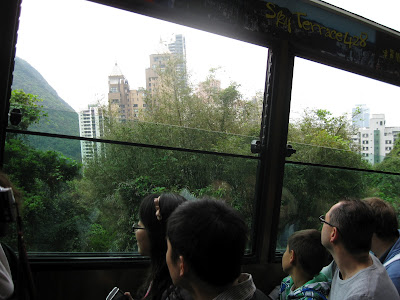
     Because it was Easter weekend the line for Peak Tram tickets was longer than usual, but when we got closer to the ticket window we jumped to a shorter line for combo tram/Madame Tousard's Wax Museum tickets.  I would not have made this choice on my own, but Yan was very sure that she wanted to do this because someone had told her that the museum was a must-see.
     The views on the less-than-15-minute tram ride up to the top of The Peak are dramatic. If you're unlucky enough to not have gotten a seat, it's a little more challenging to appreciate the views because the grade is steep much of the way and you're focused on staying on your feet.  Fortunately we had seats like these people and could admire in comfort.
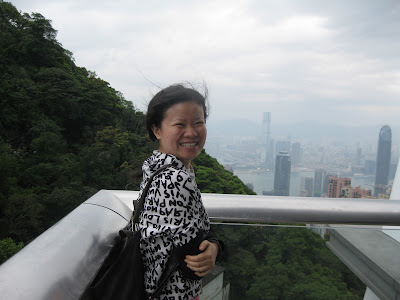
     Once at the top Yan headed right to Mme Tousard's.  She had a ball looking at all the celebrity figures--Chinese, American and British movie and sports stars, musicians, politicians--and had me take dozens of photos on her camera of her posing with many of them.  I had thought that once we were done with that we could go outside and take one of the walking paths around the mountain, which I've done before and enjoyed.  At 1800', Victoria Peak is the highest point on Hong Kong Island and has superb views of the western side of the island, Victoria Harbor, and Kowloon across the harbor on the peninsula.  It's also a lot cooler on the peak.  The first British colonialists built their homes up there to escape the summer heat and humidity down below.  Yan found it uncomfortably cold on Saturday, though, so after I took this photo of her outside and we did a quick walk to the end of the viewing platform, she was ready to take the tram back down.
     As an aside, Terry and I, like other Westerners, notice that our body thermostats are different from those of most Chinese in southern China.  When we're comfortable in shirtsleeves, many Chinese are wearing down jackets.  When it gets hot and sticky here we're sweating buckets, but most Chinese are barely glowing.
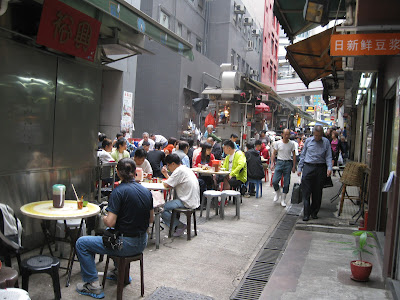
     We headed to Stanley Street next, a few blocks up from this food stall area, for lunch at Nam Kee.  Terry and I have walked by this restaurant a couple times, but we've never eaten there because it usually has a long line of Central office workers out the door on a weekday.  It's known for a great bowl of noodles for less than U.S. $4.  On Saturday there were only a couple people ahead of us in line. A tower of just-delivered boxes of dry noodles stood inside the front door.  Yan admired them approvingly, took a picture of them and told me that those particular noodles were famous in China.  I thought my wonton soup was delicious, but Yan told me outside afterwards that her noodle dish was too sweet.  She grew up in an area northeast of Shenzhen and Hong Kong, where the preference is for spicy chili condiment on most everything, instead of the not-spicy and sometimes sweet Cantonese flavors of southern China.
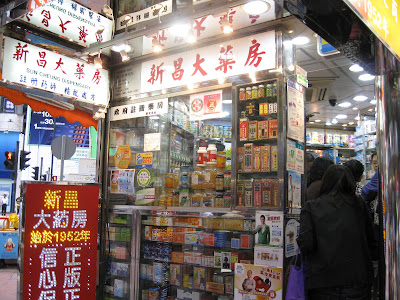
     Next we caught the tram that runs east and west along the Victoria Harbor side of Hong Kong Island and went to the Wan Chai area so she could buy presents for family and friends.  Most important on her list was 8 bottles of special "medical oil" from Singapore for her mother and grandmother and 6 aunts and uncles.  I didn't understand exactly what this oil is used for, but it sounds like sort of a cure-all for aches and pains.  She went into quite a few Chinese medicine shops, read lots of labels and compared prices and finally made her purchase at this shop.
     We hopped on the tram again and took it practically to the front door of our apartment building on the far west side of Hong Kong Island.  I wanted to drop off the present Yan had very thoughtfully brought for Terry and me, a half-dozen bags of various kinds of tea that she'd carefully picked out for us, knowing how much we enjoy this Chinese treat.
     After resting a bit and having some water and fruit, we set off to take the Star Ferry across Victoria Harbor to Tsim Sha Tsui in Kowloon, another must-do for tourists.  It takes only 5 minutes to cross the  mile-wide harbor.  This view from the ferry looking back at Hong Kong Island is particularly nice in the evening.  The skyscrapers continued to light up as we walked along the promenade on the Tsim Sha Tsui side.  I had planned on our staying for the nightly Symphony of Lights at 8:00, when 40-some buildings do a synchronized lights-laser-fireworks-music show.  Yes, the tourist checklist again.
     But after a quick dinner at a tiny Chinese restaurant up a few blocks from the harbor--Yan specifically said she wanted rice for this meal--we had to rush to the subway.  She told me as we were eating that she had to get to the Sheung Wan station back on Hong Kong Island and then find the nearby ferry terminal so she could buy a ticket and get on the last ferry back to Shenzhen at 8:30.  After we had our lunch she'd said that we needed to walk slowly so that our food would digest better.  There was no time for slow walking after this meal.  We rushed through the subway tunnels, fortunately found helpful signage to get to the ferry terminal, located the ticket window, and then said a hurried good-bye.  Yan emailed the next day that she got to the ferry only 5 minutes before departure, maybe just a little bit too exciting an end to her first trip to Hong Kong!